NYCWISE · MODULE 08 / 10
NYC Talk
Understand a fast, direct conversational style without trying to perform a New York accent. The module focuses on short, useful written examples and context.
Five screens. Five practical decisions.
These are the five topics included in this module of the final NYCWISE app.
- 01
Talk short. Get to the point.
Use concise wording on transit, in lines and during everyday requests.
On the subway, at a deli counter or on a packed sidewalk, many New Yorkers skip the extra ceremony. Short doesn’t mean hostile. It respects everyone’s time, including the line behind you.
- 02
Words that mean something different in NYC.
Learn how common local expressions can carry a different practical meaning.
In NYC, ordinary words can have local meanings.
- 03
Five NYC words you’ll actually hear.
Recognize a small set of NYC terms without overusing them.
Understand it first. Don’t force it.
- 04
“Forget about it” — accent vs reality.
Separate the familiar fictional New York accent from how diverse New Yorkers actually speak.
It’s a real phrase, and pop culture made it New York’s calling card. In real life it can mean three very different things.
- 05
Sound local without trying to sound local.
Be clear, brief and polite without forcing slang or imitating an accent.
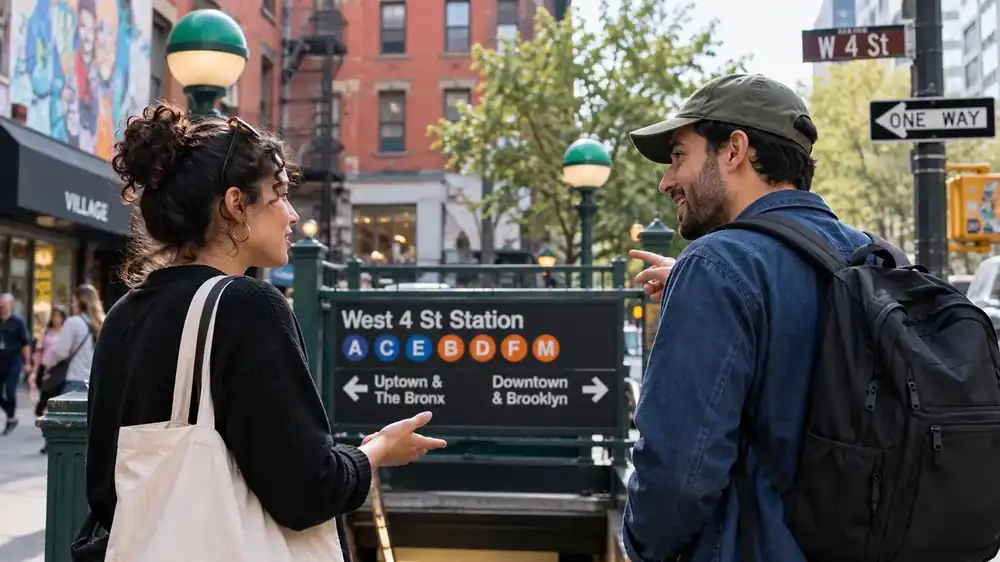
Ask the actual question: “Which way is downtown?” Skip the long introduction.
PRACTICAL NYC ANSWERS
Questions to answer before you decide
Understanding NYC conversation is about reading context, timing and intent. Memorizing an exaggerated accent does not make everyday interactions easier.
What does “you're good” mean in New York?
Often it means that a small problem is resolved: you apologized for bumping someone, and the other person is saying there is no issue. In another context it can mean “go ahead” or “you don't need to do that.” Listen to what happened immediately before the phrase; the words alone do not give you a universal translation.
Why do some New Yorkers sound unusually direct?
Short speech may be about pace and clarity, not hostility. At a crowded counter, a concise order helps keep the interaction moving. In a quieter conversation the same person may speak very differently. If you are unsure, respond politely and ask for clarification rather than assuming intent from speed or volume.
Is there one authentic New York accent to imitate?
No single accent covers all New Yorkers. The city's communities, languages, neighborhoods and generations make its speech varied. NYCWISE focuses on understanding common phrases and context, not putting on a caricatured voice. Speaking clearly in your own accent is usually a better starting point than trying to sound like a television character.
How should you ask for something when you don't understand?
Use a short, clear request: “Could you repeat that?”, “Does this train stop at…?”, or “Is that the total price?” Identify the one missing piece of information. A direct follow-up is generally more useful than pretending you understood and making an expensive mistake later.
Useful references: NYC Unwritten Rules guide · NYC Talk module and phrases. Official rules and prices may change.